- Introduction
Increasing the Kappa number has been discussed and widely studied in recent years at integrated mills in Brazil and abroad, due to factors such as:
- Higher pulp yield;
- Lower specific wood consumption;
- Lower thermal load in the digester;
- Improved paper properties (RCT, SCT, CMT, Bulk, etc.);
- Lower chemical costs;
- Meeting the demand for packaging with high mechanical strength.
This strategy has been widely used at integrated plants producing Kraftliner paper. Many plants currently aim to operate in the 80 – 100 range.
However, as Kappa increases, the fibers become stiffer due to higher residual lignin, which means higher refining energy consumption. There are also impacts on drainage and greater difficulty in balancing mechanical strength and formation, making inter-fiber bonding a major challenge.
The aim of this reflection is to show the benefits and challenges of increasing the Kappa number and its impacts on Kraftliner paper production.
- Impacts of higher Kappa on the Fiber Line
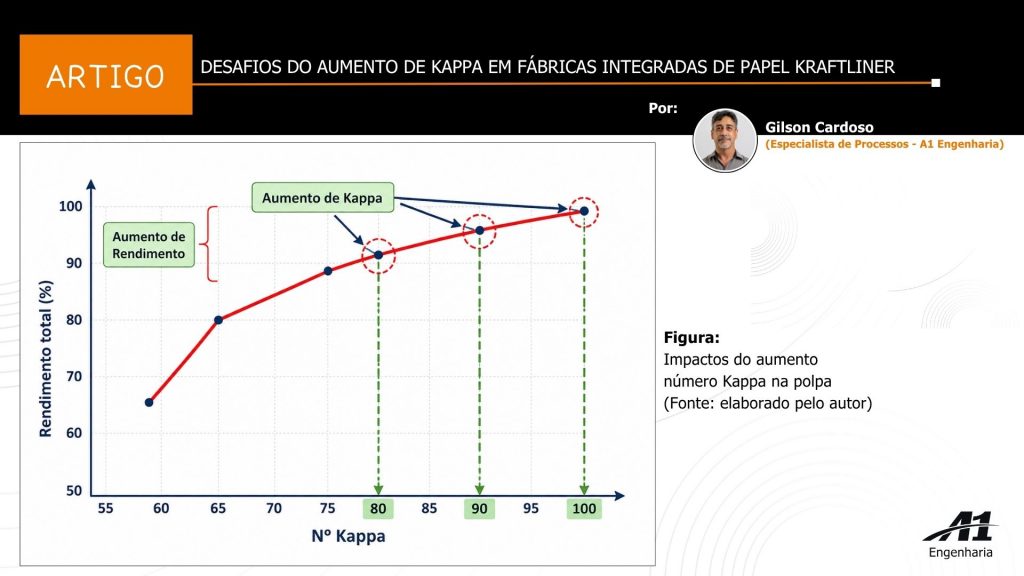
There is no doubt that the main industrial driver for increasing Kappa is higher yield and, consequently, a significant reduction in wood consumption per ton of paper. Higher yield and lower specific wood consumption become crucial factors in scenarios of high wood costs and environmental sustainability projects (Fig. 1).
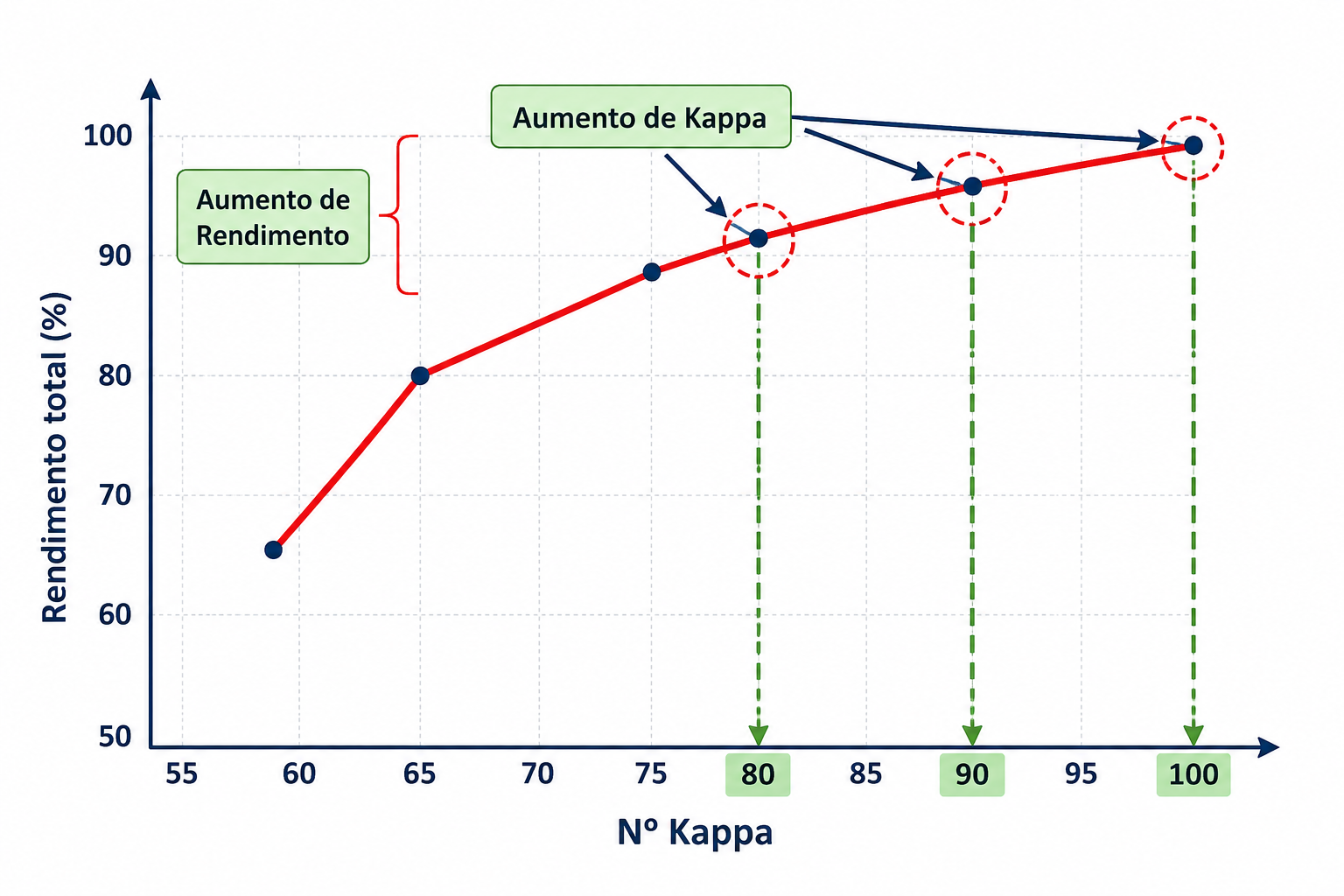
Figure 1 – Impacts of a higher Kappa number on pulp (Source: prepared by the author)
However, a very common operational problem when increasing Kappa is supplying uniform, high-quality pulp that minimizes variations and additional problems in subsequent operations (such as screening and washing) or runnability problems on paper machines (such as break frequency).
In general, higher Kappa brings “side effects” that must be considered, such as:
- Higher reject content;
- Higher energy consumption for reject refining in the fiber line;
- Lower dry solids to the recovery boiler;
- Lower energy production.
The great challenge is to minimize these side effects. The first step is to reduce Kappa number variability through better chip quality (size distribution, thickness, moisture content, etc.), white liquor quality (alkali charge, liquor-to-wood ratio, concentration, sulfidity, etc.), H-factor and residual alkali.
Another aspect worth highlighting is the impact of higher reject content on the existing screening plant, causing screen blockages and higher energy consumption to refine the rejected fraction. Uniform impregnation is therefore a key element in producing high-Kappa pulp with low reject content.
- Refining high-Kappa pulp and its effects on drainability and paper properties
Higher Kappa means stiffer, less collapsed and more hydrophobic fibers, which significantly changes their behavior in refining, drainage and drying.
There is no doubt that raising Kappa to between 80 and 100 produces stiffer fibers that provide the properties required for packaging, such as compression strength. However, during refining (stock preparation), the high lignin content means that fibrillation requires higher specific energy consumption to reach the desired refining level (°SR). In addition to higher energy consumption, the high residual lignin content negatively affects the drainability of the fiber suspension and makes sheet formation on the paper machine more difficult.
Regarding the impact of higher refining energy consumption, the first step is to optimize the hydrodynamics of the refining process itself. One strategy to save energy is to control the refiner to maintain a constant Specific Edge Load (SEL) through variable speed according to production fluctuations. Another way to reduce energy consumption is to adapt the design (geometry) of the refiner plates.
Another challenge is drainability, which depends on refining intensity. Very low intensity cannot treat the fibers effectively, but makes drainage on the forming wire easier. On the other hand, very high intensity cuts the fibers, creating a higher percentage of fines and making drainage and sheet formation more difficult. Adapting the geometry of the refiner plates therefore makes it possible to find the optimum refining intensity without compromising strength properties.
Another impact of higher Kappa that must be considered on paper machines, especially in drying, is the loss of drainage because the pulp is more lignified, requiring more thermal energy to remove water. This calls for an adjustment of the heat balance.
- Final considerations
Increasing the Kappa number represents a significant technical and economic opportunity, as long as it is accompanied by integrated adjustments in refining, drying and quality control. With rigorous monitoring and compensating practices (optimized refining, strength additives, variability control), it is possible to achieve a better overall cost-benefit ratio.
For Kraftliner papers used in packaging, the increase in refining energy and the possible reduction in machine speed due to poorer drainage are offset by the savings provided by higher yield.
- References
ANTONSSON, S.; KARLSTRÖM, K.; LINDSTRÖM, M. – Applying a novel cooking technique to produce high Kappa number pulps. Nordic Pulp & Paper Research Journal, v. 24, n° 4, p. 415-420, 2009.
CORREIA, F.M.; D’ANGELO. J.V.H.; SILVA JÚNIOR, F.G.D. – Revisitando número Kappa: Conceitos e aplicações na indústria de celulose. O Papel, v.80, n° 7, p. 77-85, 2019.
GHOSH, A. – Optimal Refining Strategy of High Yield Unbleached Long Fibre Kraft Pulp: In-situ Investigation. Available at: https://www.eucalyptus.com.br/artigos/2010_Optimum+Long+Fiber+Refining.pdf.
HART, P. W. E. – Enhancing yield through high-kappa pulping. Tappi Journal, v. 13, n. 10, p. 33-35, 2014.
KAUPPINEN, J. – High kappa refining and its effect on drainability and the technical properties of paper. 2019. Tampere University. Dissertação de Mestrado.
PATIL, R.; VAN HEININGEN, A. – Increasing packaging grade kraft pulp yield by using sodium methyl mercaptide. Journal of Wood Chemistry and Technology, v.43, n° 6, p. 337-345, 2023.