1. DIGITAL TRANSFORMATION
“Digital transformation” has, in recent years, become such a widely used expression that it has lost precision. In industrial engineering, it is invoked to justify everything from buying a license for 3D modeling software or intelligent P&IDs to migrating a collection of drawings to PDF — legitimate initiatives, but nowhere near what the term should mean.
The specialized literature clearly separates the two concepts: digitization is the conversion of analog information into digital form; digital transformation implies structural change in processes, in organizational relationships and in the way value is generated throughout an asset’s life cycle (ROGERS, 2016; OSTERWALDER; PIGNEUR, 2010).
The difference is not semantic. A company can digitize decades of drawings and keep operating with the same problems as before: fragmented information, decisions based on outdated documents, silos between departments and the same old rework the team only discovers during field assembly.
In industry, genuine transformation depends on the coherent articulation of three layers: Systems, Platforms and BIM Methodology.
A pulp and paper mill, a petrochemical unit or a gas processing facility operates with hundreds of disciplines, thousands of instrumentation tags and interdependent contractual deliverables.
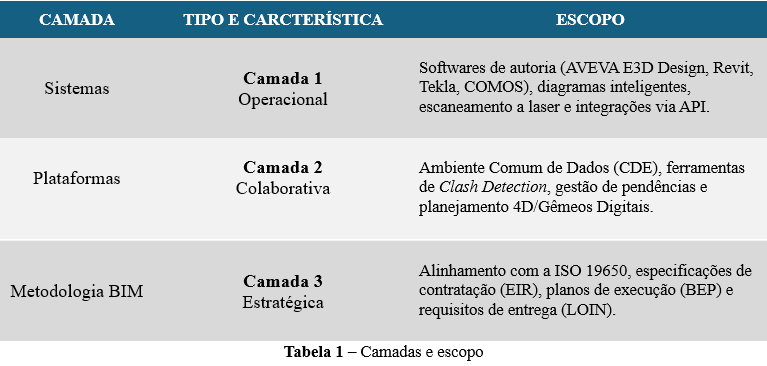
None of these layers, on its own, produces transformation. A pulp and paper mill, a thermal power unit or a petrochemical facility operates with hundreds of disciplines, thousands of instrumentation tags, commissioning schedules and interdependent contractual deliverables. Managing this complexity requires the three layers to work in an integrated, governed way. This article walks through each of them, showing its specific role and the consequences of its absence.
2. LAYER 1 – SYSTEMS: the infrastructure that connects disciplines
In any highly complex industrial project, technical information is born distributed. Civil, structural, piping, equipment, automation, instrumentation, electrical, HVAC and utilities: each discipline works with its own systems, its own conventions and often its own file formats. AVEVA E3D handles piping and 3D layout; Tekla, steel structures; COMOS and AVEVA Engineering, process flow diagrams and instrumentation; Revit, buildings, E&IA and utilities. Each of these environments produces quality information within its domain. The problem is that, historically, they do not talk to each other.
This fragmentation has direct and well-known consequences: physical clashes between piping and cable trays discovered during assembly; support structures undersized for loads from equipment added late; process data that never reaches the instrumentation database because it passes through intermediate spreadsheets. The cost of solving these problems in the field is orders of magnitude higher than the cost of having identified them during engineering (MCGRAW-HILL CONSTRUCTION, 2014).
The first layer of digital transformation is what allows these systems to talk. Open formats such as IFC (Industry Foundation Classes), governed by ISO 16739, and API integrations between engineering environments make it possible to build a federated model: a unified view of the project where each discipline contributes its part and where inconsistencies between them become visible before they reach the field. When this model is fed with the right attributes, at the granularity defined by LOIN (Level of Information Need), it becomes the project’s central technical repository (EASTMAN et al., 2011).
2.1 Connection with Asset Management Systems
The relevance of Systems does not end when the engineering contract closes. For the digital as-built to have real operational value, it must be connected to the operator’s EAM (Enterprise Asset Management) or CMMS (Computerized Maintenance Management System), the environments where maintenance orders, periodic inspections and scheduled shutdowns are managed. Without this integration, the 3D model and the engineering database end their useful life along with the EPC contract, becoming an expensive archive with no functional purpose (VOLK; STENGEL; SCHULTMANN, 2014). It is a loss that rarely appears on the project balance sheet, but one the operator feels for decades.
3. LAYER 2 – PLATFORMS: the environment where collaboration happens
If Systems produce technical information, Platforms are the environment where it is shared, reviewed, approved and tracked. The distinction matters because producing quality information is not enough if it circulates through uncontrolled channels — emails, shared folders, messaging groups — where there is no way to ensure that each team is working with the current version.
3.1 CDE – Common Data Environment
In industrial projects, technical information is not valuable for its content alone. It is valuable for the state it is in: who produced it, who approved it and whether it can be used to support a decision at that moment. This is the premise of the CDE (Common Data Environment), defined by ISO 19650-1 as the agreed environment for collecting, managing and disseminating the information containers of a project or asset throughout its life cycle (BSI, 2019).
A CDE is not a well-organized file server. It is a workflow platform, an environment that defines how each document, model or technical specification is created, changes state, and is reviewed, approved and published for use by the design, construction, assembly and operations teams.
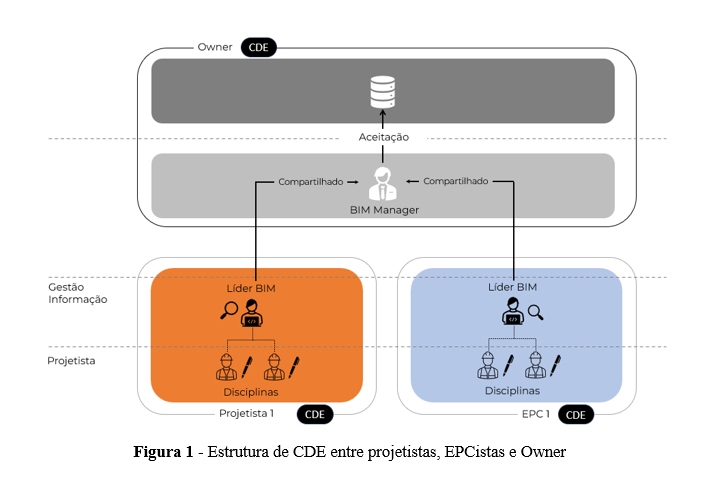
The heart of the CDE as a platform is information state control. ISO 19650 defines four states: Work In Progress (WIP), Shared, Published and Archived. In an industrial project, these states have direct and immediate operational consequences. A piping isometric in WIP cannot feed spool fabrication. A pressure vessel datasheet in the Published state is the document that supports the manufacturing order to the supplier. Ignoring this control, or treating it as a formality, is the source of much of the fabrication rework and nonconformities that appear during commissioning (AZHAR, 2011).
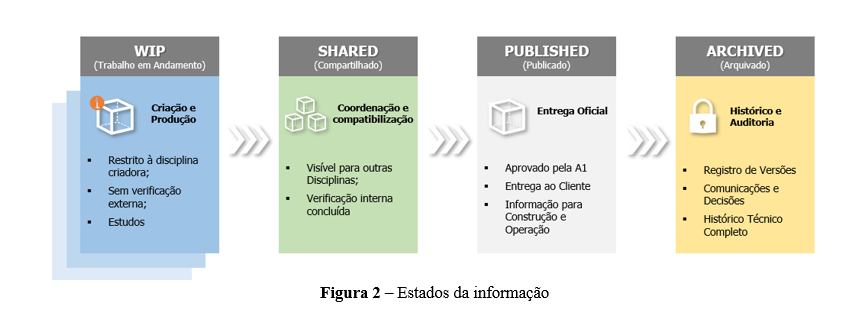
In projects with multiple contractors — EPC, assembly subcontractors, critical equipment suppliers and owner inspection — the CDE is the project’s single source of truth. When it does not exist or is not used as a real workflow, different teams inevitably work with different revisions of the same document. This scenario is not hypothetical: it is everyday life in projects that still run by email and do not discover the problem until the wrong spool has already been fabricated.
3.2 Clash Detection and Issue Management
On top of the federated model managed in the CDE, two functions have a direct impact on the quality of industrial projects: clash detection and issue tracking.
Clash detection — whether hard clashes (direct physical conflict) or soft clashes (violation of operational clearance) — when performed systematically, exposes during engineering what would otherwise be discovered during assembly at a cost potentially 10 to 100 times higher (MCGRAW-HILL CONSTRUCTION, 2014).
Structured issue tracking linked to the 3D model creates the audit trail that supports both contract management and the quality assurance requirements of ISO 9001 and industry regulations.
3.3 4D Coordination and Industrial Construction Planning
4D BIM — linking the 3D model to the execution schedule structured by WBS — makes it possible to simulate the construction sequence before any equipment reaches the field. In industrial projects, this is especially valuable for the logistics of large equipment: turbines, heat exchangers, pressure vessels. These items cannot be repositioned. Getting the arrival sequence or the lifting window wrong is not an administrative deviation; it is an engineering problem with real cost and schedule impact (SACKS et al., 2018).
3.4 Digital Twins
A digital twin is a dynamic replica of a physical asset, continuously fed by data from sensors, control systems and operating history (GRIEVES; VICKERS, 2017). Unlike the BIM model, which represents the asset at a fixed stage of development, the digital twin exists in real time: it reflects what is happening in the plant now, not what was designed.
In industry, this distinction has an important practical implication: the digital twin is not the starting point of digital transformation. It is its most mature result. A model without consistent attributes, a CDE abandoned after handover or a BEP that did not anticipate the requirements of the operating phase makes the digital twin unfeasible before it is even built.
As a platform, the digital twin brings together three flows that, in traditional industrial projects, never communicated: the asset information model, coming from BIM; real-time operating data, coming from SCADA, PI Historian and PLCs; and maintenance and integrity records, coming from the EAM and CMMS. By combining these three flows on traceable 3D geometry, it turns the information model into a decision-making environment rather than an engineering file stored on a server.
In practice, at a pulp mill or a petrochemical unit, this means the reliability engineer no longer has to manually cross-reference vibration data from the CMMS with the equipment’s physical location and intervention history. They navigate to the compressor in the 3D model and find, linked to that tag, the vibration data for the last 72 hours, the date of the last bearing replacement and the manufacturer’s recommended interval. All on the same screen. This convergence is what sets the digital twin apart from any other coordination platform: it connects design data to operating data on the asset’s real geometry.
What is crucial to understand is that this result must be planned in the EIR, structured in the BEP and built during the project, by defining which attributes need to be alive in operation, not merely present at handover. Plants that did not make this choice at the outset spend far more, years later, back-feeding a model that was developed to be delivered, not to be operated.
4. LAYER 3 – BIM METHODOLOGY: the governance that supports the other layers
Systems and Platforms are necessary but not sufficient. Without a methodology that defines how information should be produced, validated and delivered, technology tools become expensive repositories of inconsistent data. BIM Methodology is the layer that governs the other two.
The starting point is the EIR (Employer’s Information Requirements) or, in the terminology of NBR 15965, the Contracting Party’s Information Requirement. It is the document in which the asset owner specifies what information it needs, at what granularity (LOIN), at which project milestones and in which delivery formats. The EIR is what prevents the 3D model from being detailed beyond what is needed for the preliminary design phase or, conversely, from being delivered without the attributes that will feed the asset management system during operation.
In response to the EIR, the contractor prepares the BEP (BIM Execution Plan), the document that formalizes how the information requirements will be met: which tools will be used, the naming and revision structure, the disciplines’ coordination responsibilities and the approval workflow in the CDE. The BEP works as the project’s information contract (BSI, 2019).
4.1 LOIN: The question of granularity
One of the most frequent mistakes in BIM projects is developing the model at the wrong level of detail for its current phase. LOIN (Level of Information Need), aligned with ISO 19650, defines not only geometric development but also what alphanumeric and documentary information is needed at each stage, and who is responsible for it.
Figure 3 illustrates this concept applied to an electrical panel: at the conceptual phase, a simplified representation with little data is enough; at the basic phase, TAG, voltage, current and degree of protection are added; at the detailed phase, dimensions, fixings and engineering documents. In the construction and commissioning phases, the model starts to require serial number, certificates, FAT, manuals, relay settings and test records.
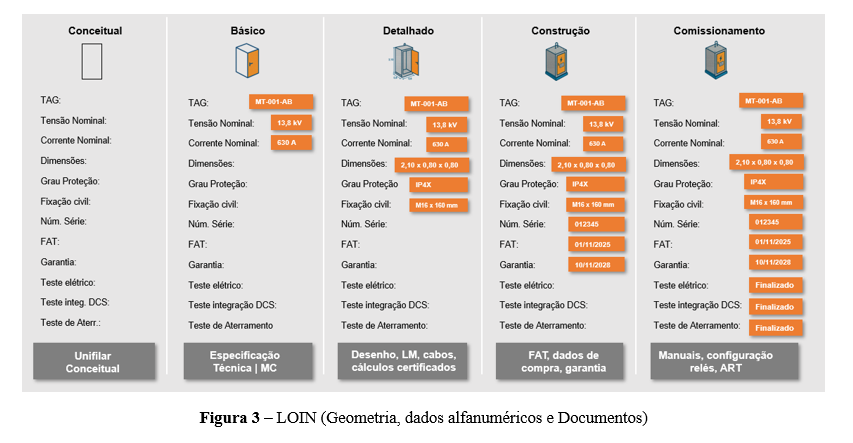
LOIN is not a progressive increase in graphic detail. It is the objective definition of what information is needed, in which phase and for what purpose. This clarity has a direct impact on engineering, procurement, fabrication, assembly, commissioning and operation.
4.2 DIGITAL HANDOVER as a strategic deliverable
Traditionally, closing an EPC contract meant delivering volumes of documentation in PDF, DOC, XLS and DWG and physically handing over the plant. In the BIM paradigm, a structured digital handover means delivering a federated model with validated attributes, to be linked later to the owner’s EAM, with all instrumentation tags, equipment lists, datasheets and commissioning procedures referenced in the corresponding model elements. This is the information asset that allows the industrial owner to reduce MTTR and optimize preventive maintenance cycles over the facility’s service life (VOLK; STENGEL; SCHULTMANN, 2014).
5. INTEGRATION AS A CONDITION – when the layers work together
Digital transformation does not emerge from the independent sum of the three layers, but from their functional, governed integration. A robust CDE without a BEP defining the workflow produces an organized repository of inconsistent information. A detailed EIR without the systems capable of producing what it specifies creates contractual expectations without technical backing. State-of-the-art modeling systems without a coordination platform result in federated models produced sporadically, with no clash traceability and no continuity throughout the project.
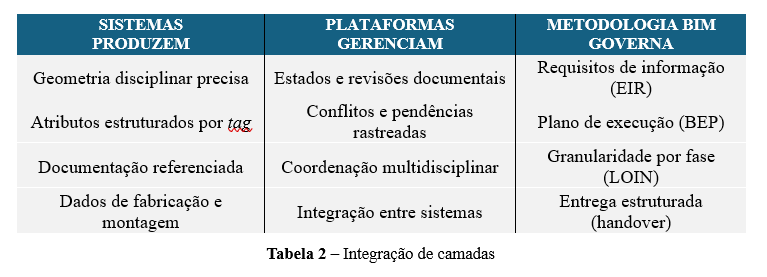
Studies of large industrial projects show that effective integration of the three layers can reduce the volume of field RFIs by up to 40%, cut rework costs by 15% to 25% and shorten commissioning time thanks to the availability of a validated information model (AZHAR, 2011; SACKS et al., 2018).
More than efficiency, these results reflect a paradigm shift: decisions are no longer made on fragmented documentation but are supported by structured, traceable and auditable information.
1. FINAL CONSIDERATIONS
Digital transformation in industrial projects requires organizational maturity, clear information objectives and commitment from all players in the chain — engineering, construction, EPC, suppliers and owner. It is not achieved by acquiring software licenses or by certifying professionals in 3D modeling or intelligent P&ID tools.
It is achieved when Systems ensure that technical information is produced accurately and interoperably across disciplines; when Platforms ensure that this information is managed with traceability and real collaboration throughout the project; and when BIM Methodology — formalized in the EIR, the BEP and the processes derived from ISO 19650 — governs how the other layers operate, for whom and for what purpose.
Industry today has all the regulatory, technological and methodological apparatus needed for this transformation. What is still often missing is the organizational decision to treat information as a strategic asset of the facility, with the same rigor applied to process engineering, pressure vessel integrity or the reliability of critical systems. This is, ultimately, the real frontier of digital transformation in industry.
References
ABNT — Associação Brasileira de Normas Técnicas. NBR 15965: Sistema de classificação da informação da construção.
AZHAR, S. Building Information Modeling (BIM): Trends, Benefits, Risks, and Challenges for the AEC Industry. Leadership and Management in Engineering.
BSI — British Standards Institution. ISO 19650-1: Organization and digitization of information about buildings and civil engineering works, including building information modelling (BIM) — Part 1: Concepts and principles. London: BSI, 2019.
BSI — British Standards Institution. ISO 19650-2: Delivery phase of assets. London: BSI, 2019.
EASTMAN, C. et al. BIM Handbook: A Guide to Building Information Modeling for Owners, Managers, Designers, Engineers, and Contractors. 2. ed. Hoboken: John Wiley & Sons, 2011.
MCGRAW-HILL CONSTRUCTION. The Business Value of BIM for Construction in Major Global Markets. SmartMarket Report. New York: McGraw-Hill, 2014.
OSTERWALDER, A.; PIGNEUR, Y. Business Model Generation. Hoboken: John Wiley & Sons, 2010.
ROGERS, D. L. The Digital Transformation Playbook: Rethink Your Business for the Digital Age. New York: Columbia University Press, 2016.
SACKS, R. et al. BIM Handbook: A Guide to Building Information Modeling for Owners, Project Managers, Designers, Engineers and Contractors. 3. ed. Hoboken: John Wiley & Sons, 2018.
VOLK, R.; STENGEL, J.; SCHULTMANN, F. Building Information Modeling (BIM) for existing buildings — Literature review and future needs. Automation in Construction.