- Introduction
International shipping accounts for more than 80% of global trade by volume and is one of the logistical pillars of the world economy. Historically, the sector has relied almost exclusively on petroleum-derived fossil fuels, especially those with high energy density and relatively low cost (IMO, 2023).
The main fuel used is heavy fuel oil (HFO), a high-viscosity, high-sulfur residue of petroleum refining. Although economically advantageous, HFO has significant environmental impacts, such as nitrogen oxides (NOₓ), sulfur oxides (SOₓ) and particulate matter (SMITH et al., 2015).
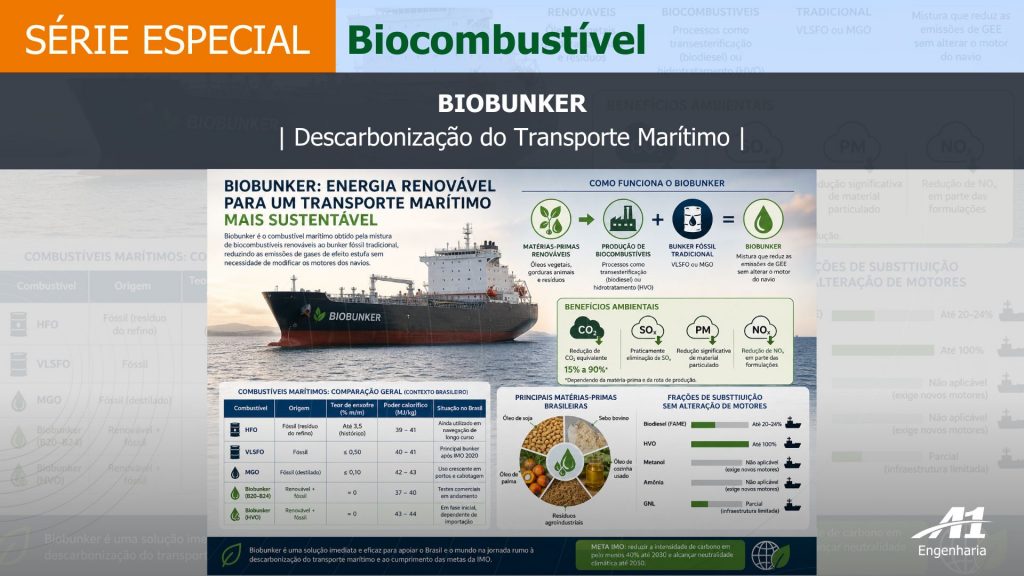
The term biobunker refers to marine fuel formulated by blending renewable liquid biofuels with traditional fossil bunker fuel, with the aim of reducing carbon intensity without requiring significant changes to ship engines or bunkering infrastructure (HEDGEPOINT, 2024). Unlike alternative fuels such as ammonia, hydrogen or methanol, biobunker falls into the drop-in category, allowing immediate use in existing marine diesel engines, provided technical blending limits and regulatory specifications are respected (LLOYD’S REGISTER, 2023).
- Biofuel options used as biobunker
Several liquid biofuels are being evaluated for use in the maritime sector, most notably FAME (Fatty Acid Methyl Ester) biodiesel and HVO (Hydrotreated Vegetable Oil). FAME is conventional (1st generation) “biodiesel” with lower long-term stability. HVO is a renewable (2nd generation) diesel that offers greater stability, superior performance and zero sulfur and aromatics.
2.1 Biodiesel (FAME)
Biodiesel, chemically classified as fatty acid methyl esters (FAME), is produced by transesterification of vegetable oils or animal fats. This fuel is already widely used in blends with road diesel and is being tested in marine applications at increasing proportions. Trials on commercial vessels have demonstrated technical feasibility for blends of up to 24% biodiesel (B24) in marine bunker fuel, with no significant impact on engine operation or fuel systems (PETROBRAS, 2024).
2.2 HVO as biobunker
HVO (Hydrotreated Vegetable Oil), also known as renewable diesel, is produced by hydrotreating vegetable oils and animal fats, resulting in a paraffinic fuel with physicochemical properties very similar to those of fossil diesel (ALSULAIMAN, 2025).
Unlike FAME biodiesel, HVO contains no oxygen in its molecular structure, giving it greater oxidative stability, better low-temperature behavior and a higher cetane number (ALSULAIMAN, 2025).
These characteristics make HVO especially attractive as biobunker, since it can be used in any proportion, up to 100%, in existing marine diesel engines without technical modifications (DNV, 2022).
- Shipping’s contribution to global warming
The maritime sector accounts for approximately 840 million tonnes of CO₂ per year, equivalent to about 2.5% to 3% of global greenhouse gas emissions (IMO, 2020).
In addition to CO₂, the use of fossil marine fuels results in significant SOₓ and NOₓ emissions, which directly affect air quality in coastal and port regions, with negative effects on human health and ecosystems (SMITH et al., 2015).
3.1 What has been done?
The International Maritime Organization has set emission reduction targets, including cutting carbon intensity by at least 40% by 2030 (IMO, 2023). This target creates a regulatory environment favorable to the adoption of biofuels.
3.2 Environmental benefits of biobunker
The main advantage of biobunker is the reduction of greenhouse gas emissions over the fuel’s life cycle. Depending on the feedstock and technological route, biofuels can deliver reductions of 60% to 90% in CO₂-equivalent emissions compared with traditional fossil fuels (DNV, 2022).
For blends such as B24, studies indicate emission reductions of around 15% to 20% on a well-to-wake basis, with no significant operational changes (PETROBRAS, 2024).
HVO produced from waste and second-generation feedstocks can achieve GHG emission reductions of more than 85%, while virtually eliminating SOₓ emissions and significantly reducing particulate matter and carbon monoxide (ALSULAIMAN, 2025).
- Main feedstocks used
Feedstocks used to produce biobunker include:
- Vegetable oils: soybean, canola, palm and other oilseeds, widely used to produce biodiesel and HVO (EPE, 2023);
- Waste oils and animal fats: used cooking oil, beef tallow and industrial fats, classified as second-generation feedstocks with lower indirect land-use impact (DNV, 2022);
- Agro-industrial residues, which contribute to the circular economy and improve the fuel’s environmental balance.
The sustainability of these feedstocks depends on robust certification and traceability systems, such as ISCC and similar schemes, ensuring effective emission reductions and avoiding negative social and environmental impacts.
- Final considerations
Biobunker is emerging as a technically viable and environmentally effective solution for the progressive decarbonization of shipping. Its ability to reduce greenhouse gas emissions, combined with compatibility with existing engines and infrastructure, gives biobunker a central role in the sector’s energy transition.
Although challenges related to production scale, costs and feedstock availability remain, biobunker represents an immediate and realistic alternative in the face of global climate targets, especially when combined with advanced biofuels such as HVO.
- References
DNV. Maritime forecast to 2050: energy transition outlook. Høvik: DNV, 2022.
EPE – EMPRESA DE PESQUISA ENERGÉTICA. Descarbonização do transporte aquaviário. Brasília: EPE, 2023.
HEDGEPOINT GLOBAL MARKETS. O potencial do mercado de biobunker. Campinas, 2024 Available at: < https://hedgepointglobal.com/pt-br/blog/mercado-de-biobunker#:~:text=e%20de%20passageiros.-,Hedgepoint%20Global%20Markets,Boa%20leitura!> Accessed: 02/18/2026
IMO – INTERNATIONAL MARITIME ORGANIZATION. IMO strategy on reduction of GHG emissions from ships. London: IMO, 2023. Available at: <https://www.imo.org/en/ourwork/environment/pages/2023-imo-strategy-on-reduction-of-ghg-emissions-from-ships.aspx> Accessed: 01/30/2026
IMO – INTERNATIONAL MARITIME ORGANIZATION. IMO Interim Guidance on the Carriage of Blends of Biofuels and Marpol Annex I Cargoes By Conventional Bunker Ships. Circ 917, Londres: IMO, 2025. Available at:
ALSULAIMAN, A.; RIBEIRO, G. C.; BRITO, T.; CAPAZ, R.; SEABRA, J. Drop In Decarbonization: Techno‑Economic Benchmarks, Hydrogen Needs, and Policy Design of SAF and Renewable Diesel The Oxford Institute for Energy Studies, Oxford, 2025
PETROBRAS. Teste de biobunker com 24 % de biodiesel em embarcações comerciais. Rio de Janeiro: Petrobras, 2024. Available at: < https://agencia.petrobras.com.br/w/sustentabilidade/petrobras-testa-combustivel-maritimo-com-24-de-conteudo-renovavel:> Accessed: 02/18/2026
SMITH, T. W. P. et al. Third IMO GHG study 2014. Londres: IMO, 2015. Available at: <https://www.imo.org/en/ourwork/environment/pages/greenhouse-gas-studies-2014.aspx> Accessed: 01/30/2026