- Introduction:
Sustainable Aviation Fuel (SAF) refers to liquid fuels produced from renewable feedstocks that can partially or fully replace fossil jet fuel (Jet A-1). SAF’s main technical feature is that it is a “drop-in” fuel: it can be used in existing commercial aircraft without modifying engines, fuel systems or airport infrastructure (EASA, 2025).
This compatibility is possible because, after processing, SAF has physicochemical properties similar to Jet A-1 and meets the specifications of ASTM D7566. Currently, SAF may be blended with conventional jet fuel in authorized proportions of up to 50%, maintaining performance, operational safety and reliability standards equivalent to fossil fuel (ASTM, 2023).
Unlike other decarbonization solutions still under development, such as electric or hydrogen-powered aircraft, SAF is an immediate and scalable alternative and is now considered the main lever for reducing greenhouse gas (GHG) emissions in aviation.
- Environmental benefits compared with jet fuel
Aviation accounts for approximately 2.5% to 3% of global CO₂ emissions, with an even larger share when non-CO₂ climate effects are considered, such as the formation of condensation trails (persistent contrails) (ICAO, 2011). SAF stands out for delivering significant emission reductions over the fuel’s entire life cycle.
A study by EASA indicates that using SAF can reduce GHG emissions by up to 91% (EASA, 2025). The reduction depends on the production process; potential reductions exceed 90% when hydrogen is produced with renewable electricity and CO₂ is captured from biogenic sources or directly from the atmosphere (IEA, 2022).
Beyond directly mitigating carbon emissions, SAF offers additional benefits: lower aromatic and sulfur content and lower particulate emissions, resulting in cleaner combustion (CHOOOSE, 2024). Lower emissions of fine particulate matter and soot help reduce the formation of persistent contrails, which account for a significant share of aviation’s radiative effect on global warming (ICAO, 2011). These effects make SAF a relevant solution not only for controlling CO₂ but also for mitigating the total climate impact of air transport.
- The role of SAF under CORSIA
CORSIA (Carbon Offsetting and Reduction Scheme for International Aviation), created by the International Civil Aviation Organization (ICAO), is the main global mechanism for controlling the growth of CO₂ emissions from international aviation. The program requires emissions above baseline levels to be offset through carbon credits or through the use of eligible sustainable fuels (ICAO, 2019).
SAF plays a strategic role because it reduces emissions directly at the source, lowering the need for external offsets. Under CORSIA rules, only fuels that meet strict sustainability criteria and demonstrate minimum life-cycle GHG reductions of 10% can be considered eligible, and approved SAF typically far exceeds that threshold (ICAO, 2023).
SAF currently costs more than fossil jet fuel (IEA, 2024). However, in Brazil, using SAF may be more economically efficient than continuously buying carbon credits, especially as credit prices rise and global regulatory mandates tighten (EPE, 2025). SAF therefore not only helps meet CORSIA requirements but also reduces regulatory and financial risks for airlines.
- Feedstocks used to produce SAF
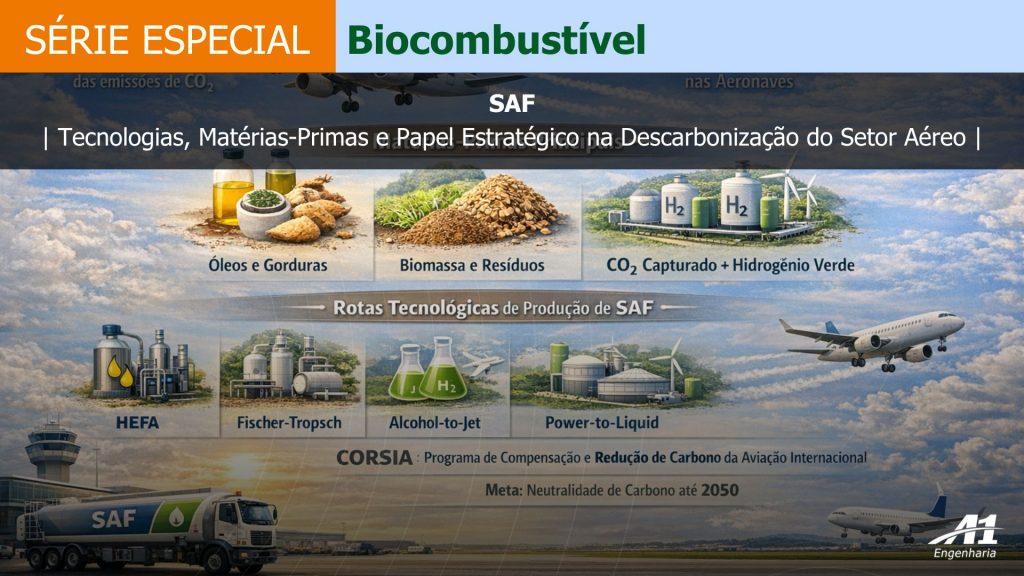
The sustainability of SAF is directly linked to the feedstocks used to produce it. The main categories include:
4.1 Oils and fats
Vegetable oils, animal fats and used cooking oil are currently the main feedstocks used to produce SAF. These inputs have high energy density and are compatible with mature technological routes such as HEFA (ASTM, 2023). However, global availability is limited and insufficient to meet aviation’s total fuel demand (IEA, 2025), which reinforces the importance of diversifying biomass sources. In this context, initiatives such as the Acelen Renováveis project — which is developing a new source of vegetable fat — represent a promising alternative for expanding the sustainable supply of feedstocks (ACELEN, 2026).
4.2 Lignocellulosic biomass
Agricultural and forestry residues, such as straw, sugarcane bagasse and wood waste, have great potential due to their wide global availability. Brazil, for example, generates more than 200 million tonnes of lignocellulosic residues per year, a significant base for producing SAF from organic waste (EPE, 2024). To be used as feedstock, lignocellulosic biomass undergoes complex treatments to convert its rigid structure into fermentable sugars or syngas.
4.3 Captured CO₂ and renewable hydrogen
Routes based on captured CO₂ and green hydrogen are a long-term alternative with high scale-up potential. They make it possible to decouple SAF production from biomass availability, although they still involve high costs and technological challenges (IEA, 2024).
- Main SAF production technology routes
5.1 HEFA (Hydroprocessed Esters and Fatty Acids)
The HEFA route uses vegetable oils (soybean, corn, palm, used cooking oil, animal fat and fat residues). The chemical process involves hydrogenation (use of hydrogen) to remove oxygen from the biomass, followed by processes to adjust the molecules to jet fuel specifications. Its main advantage is technological maturity, as it is chemically almost identical to conventional jet fuel; its limitation is feedstock availability.
5.2 Fischer-Tropsch (FT)
The FT route converts carbon-rich feedstocks — such as biomass, municipal solid waste or captured CO₂ — into syngas (H₂ + CO) and then into synthetic hydrocarbons. It is based on gasifying biomass or waste to produce syngas, followed by catalytic synthesis. This technology offers greater feedstock flexibility but is less technologically mature.
5.3 Alcohol-to-Jet (AtJ)
AtJ technology converts alcohols, mainly ethanol and isobutanol, into Sustainable Aviation Fuel (SAF) through dehydration, oligomerization, hydrogenation and separation. Converting alcohols into jet fuel is an attractive alternative, especially in countries with strong ethanol production, such as Brazil and the United States. The AtJ route is still being consolidated commercially but has good potential for integration with existing supply chains (PETROBRAS, 2025).
5.4 Power-to-Liquid (PtL)
The PtL route is considered the most promising in terms of climate neutrality. It is a synthetic fuel produced from renewable electricity (solar/wind), water and captured CO₂, using electrolysis to create green hydrogen that is combined with CO₂. The main obstacle today is the high production cost.
- Conclusion
Sustainable Aviation Fuel is currently the main solution available at scale for reducing emissions from aviation. Its compatibility with existing aircraft, combined with significant GHG reductions and additional environmental benefits, positions SAF as a central element of decarbonization strategies and of compliance with regulatory mechanisms such as CORSIA.
Despite its potential, global SAF production is still limited. In 2025, world production was estimated at about 2.7 billion liters (IATA, 2025), less than 1% of the total aviation fuel consumption needed to reach climate neutrality targets by 2050. In other words, production will need to grow to tens of billions of liters per year.
A1 Engenharia works strategically alongside clients and partners to implement vegetable oil plants and SAF production units. We combine solid experience in mature technologies with the ability to develop innovative solutions, from pilot plant through scale-up and large-scale operation. Our commitment is to turn concepts into robust, efficient projects ready to meet the growing demands of the energy transition.
>