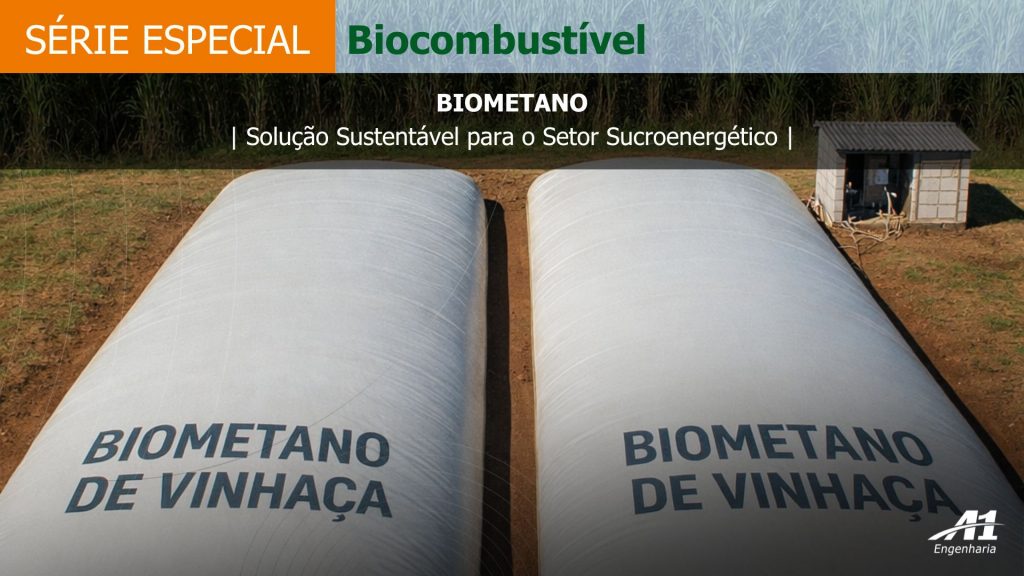
The Brazilian sugar-energy industry is recognized for its excellence in producing ethanol, sugar and bioelectricity. However, there are still opportunities to add value to its by-products, such as vinasse. Traditionally applied to the soil as fertilizer, vinasse is rich in nutrients, but its large volume and pollution potential create logistical and environmental challenges.
The great challenge of vinasse — its volume and pollution potential — can become a strategic opportunity through biomethane production. With advances in anaerobic digestion technologies and growing demand for renewable energy sources, converting vinasse into biogas — and then into biomethane — has become one of the greatest opportunities for innovation, efficiency and decarbonization in the sector. Brazil produced about 318 billion liters of vinasse in the 24/25 harvest, with the potential to generate 5.8 billion Nm³ of biogas (ESTEVES, 2020; EMBRAPA, 2025)
This article explores the energy potential of this conversion, the agronomic value of digested vinasse and some strategic applications of biomethane, including its integration with solar power generation.
- Vinasse: Environmental Challenge and Strategic Resource
Vinasse is generated after fermentation of cane juice or molasses and subsequent distillation of ethanol. For each liter of ethanol produced, an average of 10 to 14 liters of vinasse is generated. It is an effluent with a high organic load, moderate acidity and a high concentration of nutrients, especially potassium (K), as well as nitrogen (N), calcium (Ca), magnesium (Mg) and carbonaceous organic matter (SOARES et al., 2013). Anaerobic digestion is an alternative capable of turning vinasse into a source of revenue. In addition, digested vinasse retains its value as a fertilizer, with even more attractive agronomic characteristics (ELIA NETO, 2019).
- Vinasse Digestion and Biogas/Biomethane Production
Anaerobic digestion is the process in which microorganisms break down organic matter in the absence of oxygen, generating biogas (a mixture of methane and CO₂) and digestate (stabilized liquid and solid material). In the case of vinasse, the biogas from this process contains (MORAES et al., 2015):
- 50% to 65% methane (CH₄)
- 35% to 45% carbon dioxide (CO₂)
- Traces of H₂S and other gases
After purification, CO₂ and H₂S are removed, producing biomethane, a fuel equivalent to natural gas (ANEEL, 2008).
2.1. Advantages of vinasse digestion
- Significant reduction of organic load and pollution potential (CETESB, 2022)
- Production of renewable energy, reducing dependence on fossil fuels.
- Possibility of carbon credit certification.
- Firm power generation, unlike intermittent sources such as solar
- Growing economic viability with biomethane production (ABIOGÁS, 2024).
- Digested Vinasse: A Potassium-Rich Fertilizer
An essential point is that digestion does not destroy the mineral nutrients in vinasse. After the organic compounds are converted into biogas, the nutrients remain in the digestate (SOARES et al., 2014). This means digested vinasse is still a highly efficient fertilizer, mainly as a source of potassium, and it also becomes more stable and less odorous.
3.1. Agronomic benefits of digestate
- Reduced odors and degradable organic matter.
- More stable nutrients with efficiency equal to or greater than raw vinasse.
- Lower risk of water contamination.
Digested vinasse thus retains its fundamental role as a fertilizer, while the process generates renewable energy and reduces environmental impacts.
- Uses of Biomethane
Biomethane is a renewable gas with properties virtually identical to fossil natural gas and can replace it in all applications. This versatility opens up a range of opportunities for the sugar-energy sector (ABIOGÁS, 2024). Below we explore four of the most strategic uses:
4.1. Injection into the Natural Gas Grid
When the mill is located near the natural gas distribution system, biogas can be purified and sold directly by injecting it into the grid.
Advantages:
- A new recurring revenue stream.
- High commercial value, tracking the price of natural gas.
- Lower emissions in the gas distribution sector.
States such as São Paulo and Ceará already have private projects and partnerships between mills and distributors to inject biomethane into the grid. EPE (2023).
4.2. Replacing Diesel in the Mill’s Agricultural Fleet
Replacing diesel with biomethane in tractors, harvesters and trucks has great economic potential, since harvesting, transshipment and transport account for a significant share (about 15%) of mills’ total production cost.
This can be done in two ways:
- Engines originally running on diesel converted to “dual fuel” technology, using blends of biomethane plus a small fraction of diesel for ignition (LANDIRENZO, 2021).
- New equipment already designed to run on 100% gas (more common in road trucks, such as Iveco and Scania models).
Advantages
- Up to 90% reduction in CO₂-equivalent emissions.
- Lower cost per km traveled.
- Lower operating noise and greater range.
For mills with a large internal fleet, the diesel savings — and therefore the financial benefit — are especially significant.
4.3. Converting Light Vehicles (Otto Cycle) to Biogas
Light vehicles with Otto-cycle engines, such as utility vehicles in the mill’s administrative fleet, can be converted to run on CNG/biomethane relatively easily (COMPAGAS, 2024). Since biomethane is chemically equivalent to CNG, the same commercial conversion kits can be used.
Benefits:
- Significant reduction in cost per kilometer.
- Lower emissions than gasoline and hydrated ethanol.
- Use of energy produced in-house by the mill itself.
For internal trips or travel between nearby units, it is a practical and economically attractive alternative.
4.4. Power Generation Integrated with Solar Energy
Electricity can be generated from biogas/methane using natural gas generator sets, which are widely available on the market. Alongside the growth of solar photovoltaics, a highly strategic synergy emerges: running the biogas generators only when solar power is unavailable. According to Lima (2025), biogas can be stored, allowing the generators to be started when solar is not producing.
In other words:
- During the day: solar power meets demand and/or feeds into the grid.
- At night, in the early hours or on cloudy days: biogas generation takes over.
- This complementarity is strategic for the national power system, as it guarantees capacity and continuous electricity production, increasing the reliability of renewable energy.
Because it can be stored (in gas holders or as compressed biomethane), biogas works like a chemical battery, ensuring firm power even with the intermittency of the solar resource.
- Conclusion
Converting vinasse into biogas and biomethane is currently one of the greatest opportunities in the sugar-energy sector. The process:
- Generates renewable energy, reduces environmental impacts and contributes to national and international decarbonization targets;
- Preserves the agronomic value of vinasse as a potassium-rich fertilizer;
- Opens markets for selling biomethane and carbon credits;
- Integrates seamlessly with modern solar generation systems;
- Increases revenue for sugarcane processing mills.
With mature technologies and favorable energy policies, biomethane is set to become one of the pillars of Brazil’s green economy. For the sugarcane industry, it is not just an energy alternative but a strategic path to greater competitiveness, lower costs and added value for a historically underused residue.
Beyond the established technologies for using biomethane, new and still little-explored possibilities are emerging, such as its use as a feedstock for producing green hydrogen, plastics and fertilizers, and in CCS (carbon capture and storage). These applications broaden biomethane’s role in the energy transition and point to a promising horizon for innovation in the sector, a topic that deserves deeper study in the future.
A1 Engenharia has the expertise to support clients with basic, conceptual and detailed design of biogas production projects, taking into account the various opportunities and economic feasibility. Our role is to help answer questions such as: How much does a mill save by replacing diesel with biomethane? What is the average payback of a biomethane grid-injection project? What is the payback of a power generation system using biomethane generators?
References
ABIOGÁS – Associação Brasileira de Biogás. Panorama do Biogás no Brasil. São Paulo, 2024. Available at: <https://abiogas.org.br/wp-content/uploads/2025/06/PANORAMA-DO-BIOGAS-2024.pdf>. Accessed: Dec. 12, 2025.
ANEEL – Agência Nacional de Energia Elétrica. Atlas de Energia Elétrica do Brasil – Capítulo Biogás. 3. ed. Brasília, 2008.
CETESB – Companhia Ambiental do Estado de São Paulo. Vinhaça – Critérios e Procedimentos para Aplicação no Solo Agrícola. São Paulo, 2006.
COMPAGAS. Conversão de veículos para GNV ganha agilidade e economia no Paraná. Technical report, 2024. Available at: <https://www.compagas.com.br/blog/conversao-de-veiculos-para-gnv-ganha-agilidade-e-economia-no-parana.html>. Accessed: Dec. 15, 2025.
ELIA NETO, A. Vinhaça: biofertilizante e energia sustentável. São Paulo, 2019. Available at: <https://unica.com.br/noticias/vinhaca-biofertilizante-e-energia-sustentavel/>. Accessed: Dec. 12, 2025.
EMBRAPA – Empresa Brasileira de Pesquisa Agropecuária. Cana-de-açúcar. Brasília, 2025. Available at:
https://www.embrapa.br/agencia-de-informacao-tecnologica/cultivos/cana-de-acucar#:~:text=Produ%C3%A7%C3%A3o%20de%20a%C3%A7%C3%BAcar%20e%20etanol,..%5D%2C%202025)
EPE – Empresa de Pesquisa Energética. Panorama do biometano. Rio de Janeiro, 2023. (available at https://www.epe.gov.br/pt/publicacoes-dados-abertos/publicacoes/panorama-do-biometano-setor-sucroenergetico)
ESTEVES, H. B. B. Biogás no Brasil: Visão atual e futura. VII Fórum Biogás. Rio de Janeiro, 2020. Available at: <https://www.epe.gov.br/sites-pt/sala-de-imprensa/noticias/Documents/APRESENTAÇÃO_ABIOGÁS_VII_Fórum_Biogas_2020_EPE_Final.pdf>. Accessed: Dec. 15, 2025.
LANDIRENZO. Sistema Diesel/Gás – Dual Fuel. Available at: <https://www.landirenzo.com.br/sistema-diesel-gas-dual-fuel/#>. Accessed: Dec. 15, 2025.
LIMA, H. Q. Biogás como bateria. Technical article, 2025. Available at: <https://biogaseenergia.com.br/biogas-como-bateria>. Accessed: Dec. 12, 2025.
MORAES, B. S.; ZAIAT, M.; BONOMI, A. Anaerobic digestion of vinasse from sugarcane ethanol production. Applied Energy, 2015. Available at: <https://www.sciencedirect.com/science/article/abs/pii/S1364032115000337>. Accessed: Dec. 13, 2025.
SCANIA. Caminhões Scania a Gás. Available at: <https://www.scania.com/br/pt/home/products/trucks/gas-truck.html>. Accessed: Dec. 12, 2025.
SOARES, M. R.; CASAGRANDE, J. C.; NICOLOSO, R. V. Uso da vinhaça da cana-de-açúcar como fertilizante. Embrapa, 2014.
Lorem ipsum dolor sit amet, consectetur adipiscing elit. Ut elit tellus, luctus nec ullamcorper mattis, pulvinar dapibus leo.