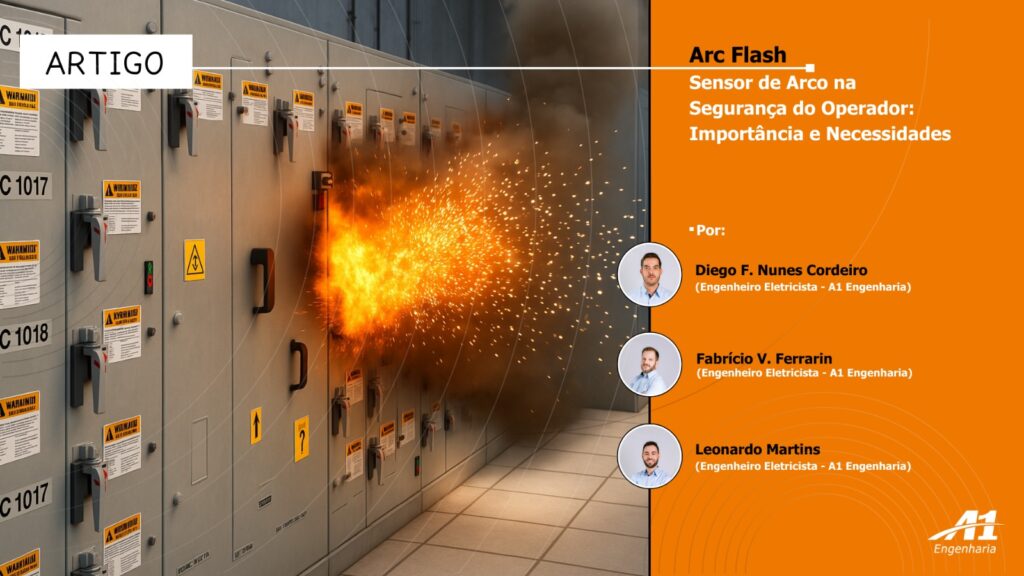
Safety in the industrial environment is a priority that requires constant technological evolution and awareness. One of the most critical threats to the safety of workers in electrical installations is the phenomenon known as Arc Flash. This high-energy event can cause serious injury and even be fatal, resulting in burns, explosions and the release of toxic gases. More than 80% of electrical accidents result from electric arcs and the ignition of flammable clothing. Given this threat, arc flash sensors stand out as an essential tool for operator safety, both for preventing and for mitigating risks.
What is Arc Flash?
Arc Flash is a phenomenon that occurs when the dielectric of the medium (usually air) breaks down during a phase-to-phase or phase-to-ground short circuit. This event suddenly releases an immense amount of thermal and radiant energy, with temperatures that can reach 20,000 °C, creating an extremely dangerous environment for anyone operating or maintaining electrical installations. The main effects of an electric arc are:
- High temperatures
- Rise in air pressure, acting as an explosive impact
- Release of vapors and gases harmful to health
- Projection of debris, with emission of solid, liquid and gaseous particles
- Intense light
- Loud bang
How to calculate Arc Flash energy?
The IEEE 1584-2018 standard, titled “Guide for Performing Arc-Flash Hazard Calculations”, is a technical guide developed by the Institute of Electrical and Electronics Engineers (IEEE). It provides specific guidelines for analyzing, calculating and mitigating the risks associated with electric arcs in industrial and commercial electrical systems. These risks include severe burns, fires and equipment damage, as well as impacts on worker safety.
The main objectives of IEEE 1584-2018 are to:
- Calculate the incident energy generated by an electric arc, expressed in cal/cm².
- Determine safe working distances, known as “arc flash boundaries”.
The calculation models and equations in this standard apply to installations with operating voltages between 208 V and 15,000 V, at frequencies of 50 Hz and 60 Hz.
According to the National Fire Protection Association (NFPA 70E), Arc Flash risk analysis is a mandatory requirement to ensure the safety of operators and technicians. The risks of an electric arc include:
- Burns, which can be fatal even when the person is a few meters away
- Objects thrown at high speed
- Air displacement with enough pressure to throw a person considerable distances
- Clothing catching fire
- Hearing loss due to the sound blast
- Loss of vision, with drying of the retina due to the high temperatures
- Poisoning by toxic gases
The Importance of Arc Flash Sensors
The time it takes to clear an electric arc is crucial to mitigating harm to the operator’s health and damage to equipment:
- Up to 500 ms: serious injury to people and equipment damage
- Up to 100 ms: no serious injury to people and minor equipment damage (light repairs)
- Up to 35 ms: minor injury to people and negligible equipment damage
Several techniques are used to reduce fault clearing time, such as time-graded selectivity, setting low-voltage trip units below the arc current, and replacing electromechanical relays with digital relays with optimized settings, among others. However, one device that has proven highly effective is the arc monitoring relay.
An arc flash sensor is a device that detects the presence of an arc in an electrical system and triggers safety mechanisms, such as immediate power shutdown or visual and audible alarms. The sensor can identify the arc before it grows to critical levels, significantly reducing workers’ exposure time. Fast detection is a crucial factor in avoiding the serious consequences of Arc Flash. Compared with traditional protection methods such as circuit breakers, arc sensors can act within milliseconds, which can be decisive in protecting human life and system integrity.
Based on the reduced clearing times achieved with arc sensors, the actual incident energy is determined, calculated according to IEEE 1584-2018. This energy is the basis for determining the appropriate clothing to protect workers against arc flash hazards, as set out in NFPA 70E and summarized in Table 1.
Table 1 – Hazard Categories x Protective Clothing
| EQUIPAMENTOS DE PROTEÇÃO POR CATEGORIA | ENERGIA INCIDENTE | TOTALIZAÇÃO DA CATEGORIA CONFORME IEEE 1584 | |
|---|---|---|---|
| CATEGORIA 1: Camisa e calça comprida resistentes a arco + Protetor facial resistente a arco + Capacete + Óculos de segurança + Protetor auricular + Calçado de segurança | 0,0 – 1,2 cal/cm² | #CATEGORIA 1 = 45 | (*N_ka) – Out of IEEE 1584 kA Range. Lee Equation Used. Consider NESC/EPRI method to compare. |
| CATEGORIA 1: Camisa e calça comprida resistentes a arco + Protetor facial resistente a arco + Capacete + Óculos de segurança + Protetor auricular + Calçado de segurança | 1,2 – 4,0 cal/cm² | #CATEGORIA 2 = 21 | (*N3) – Arcing Current Low Tolerances Used. |
| CATEGORIA 2: Camisa e calça comprida resistentes a arco + Protetor facial resistente a arco e balaclava + Capacete + Óculos de segurança + Protetor auricular + Calçado de segurança | 4,0 – 8,0 cal/cm² | #CATEGORIA 3 = 43 | (*N6) – Special Instantaneous Protectio. |
| CATEGORIA 3: Camisa e calça comprida resistentes a arco ou macacão + Capuz carrasco resistente a arco + Capacete + Óculos de segurança + Protetor auricular + Calçado de segurança | 8,0 – 25,0 cal/cm² | #CATEGORIA 4 = 24 | (*N9) – Max Arcing Duration Reached. |
| CATEGORIA 4: Camisa e calça comprida resistentes a arco ou macacão + Capuz carrasco resistente a arco + Capacete + Óculos de segurança + Protetor auricular + Calçado de segurança | 25,0 – 40,0 cal/cm² | PERIGOSO! = 20 | (*N14a) – INST Protection. User to define trip time. |
| PERIGOSO!: Não há EPI Apropriado | 40,0 – 999,0 cal/cm² | IEE 1584 2018 Bus Report – IEC909 Fault (80% Cleared Fault Threshold, include Ind. Motors ≥ 50hp for 5 | |
| For additional information refer to NFPA 70 E, Standard for Electrical Safety in the Workplace. | Device with 80% Cleared Fault Threshold | ||
Source: NFPA 70: National Electrical Code (Article 130: Work Involving Electrical Hazards).
Implementation Benefits and Requirements
The main benefit of installing arc sensors is direct protection of the operator, reducing the risk of fatal accidents. Other benefits include:
- Reduced equipment damage: the sensor’s fast response prevents the electric arc from causing permanent damage to critical components.
- Increased system reliability: with protection in place, the electrical system operates more stably and with lower chances of failure.
- Lower maintenance costs: Arc Flash incidents can cause significant losses, both from equipment replacement and from operational downtime.
However, for arc sensors to be implemented effectively, certain conditions must be met:
- Suitability for the electrical design: sensors must be compatible with the layout and specifics of the installation and positioned in critical areas where the risk of Arc Flash is highest.
- Staff training: operators and maintenance teams must be properly trained to understand how the sensors work and the safety protocols.
- Regular maintenance and testing: sensor performance must be checked periodically to ensure its effectiveness.
Conclusion
The arc flash sensor is a vital technology for safety in low-, medium- and high-voltage electrical environments. It can save lives by detecting and mitigating Arc Flash risks.
Awareness and the adoption of preventive practices are essential to reduce operational risks. Ensuring these devices are correctly installed, maintained and operated is a fundamental step toward a safe and efficient workplace.
Diego Fernando Nunes Cordeiro
Electrical Engineer – A1 Engenharia.
- Industrial Electrical Engineering;
- Postgraduate in Power System Protection;
- MBA in Project Management.
Fabrício Vieira Ferrarin
Electrical Engineer – A1 Engenharia.
- Electrical Engineer;
- Postgraduate in Industrial Engineering;
- MBA in Project Management;
- Postgraduate in Electrical Power Systems.
Leonardo Martins
Electrical Engineer – A1 Engenharia.
- Electrical Engineer;
- Postgraduate in Electrical Power Systems;
- MBA in Project Management.