- Introduction
Bioethanol is a renewable liquid biofuel obtained mainly through the fermentation of sugars found in agricultural feedstocks. With growing pressure to reduce greenhouse gas (GHG) emissions, ethanol is a leading player in the energy transition as a renewable alternative for road transport. Its use as an automotive fuel is one of the most successful experiences of partially replacing fossil fuels in the transport sector, especially in Brazil. Over recent decades, bioethanol has gone through cycles of expansion, crisis, technological innovation and feedstock diversification, establishing itself as a pillar of the energy transition in several countries.
- Origins of ethanol as a fuel
The use of ethanol as an automotive fuel dates back to the early 20th century, when internal combustion engines were developed to run on alcohol, gasoline or blends of both — as originally envisioned by Henry Ford for the Ford Motor Company’s Model T (FORD MEDIA CENTER, 2025). However, Prohibition in the US, the closure of distilleries and the consolidation of the oil industry, combined with low oil prices throughout the 20th century, hindered the project, which was set aside until it re-emerged in major government programs in the following decades.
Pró-Álcool, launched in Brazil in 1975 in response to the first oil crisis (1973), had government support through financing, guarantees and pricing policies, encouraging the construction of mills and the production of alcohol-powered vehicles. Throughout the 1980s and 1990s, Brazil built a robust production chain, with millions of vehicles running exclusively on alcohol and a nationwide distribution infrastructure. The sector went through crises, especially in the 1990s and early 2000s, linked to falling oil prices, reduced incentives and market instability. These events led to a drop in ethanol’s share at certain stages. The decisive turning point came in 2003 with the introduction of flex-fuel vehicles — able to run on any proportion of ethanol and gasoline. This technology eliminated the supply risk perceived by drivers and boosted ethanol demand, creating a predominantly flex fleet and strengthening domestic consumption of the biofuel. (ANFAVEA, 2025)
- Recent expansion: corn ethanol in Brazil
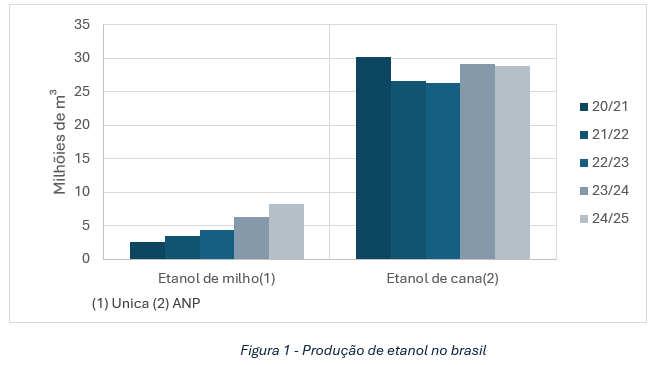
In Brazil, corn ethanol production gained importance from the 2010s onward as a complement to traditional sugarcane production. In 2024, the country produced about 34.96 billion liters of ethanol, of which 8.2 billion liters came from corn, reflecting growth of about 32.8% over the previous year. Factors driving this route include the high availability of second-crop (safrinha) corn, unfavorable logistics for grain exports, and the use of corn ethanol for production during the sugarcane off-season. Today, several plants operate in flexible or dedicated mode, complementing national ethanol production.
- Industrial ethanol production process
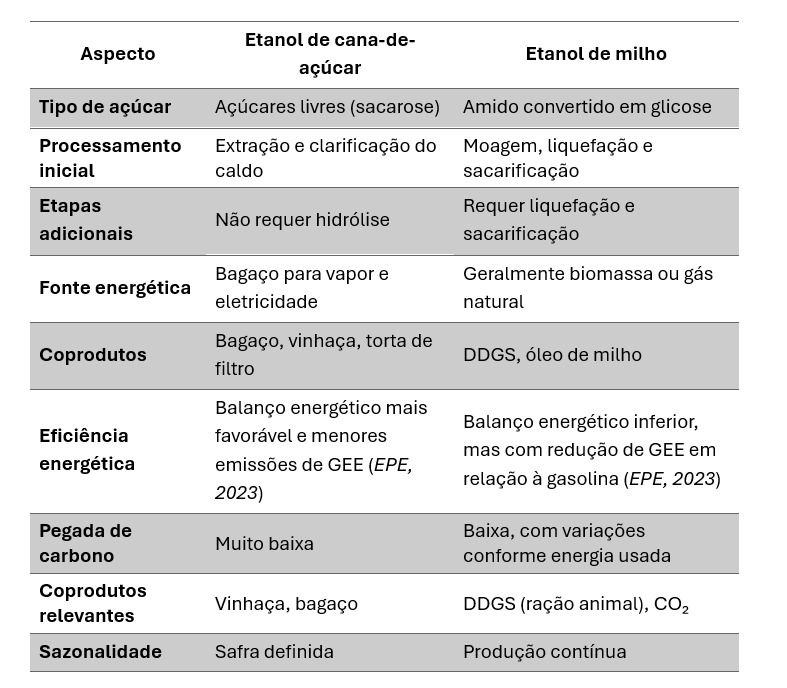
Sugarcane and corn ethanol production processes are both based on fermentation. Their characteristics, similarities and main differences are listed in the table below:
- Final considerations
Ethanol production drives extensive supply chains — from inputs (fertilizers, machinery) to fuel transport and distribution. The expansion of corn ethanol in Brazil adds value to local agricultural production and helps make full use of industrial capacity during the sugarcane off-season.
Bioethanol is a central component of the renewable energy mix in countries such as Brazil and the United States, acting as an agent for reducing GHG emissions, a driver of the rural economy and an instrument of energy security. Feedstock diversification — from traditional sugarcane to corn in Brazil and corn in the US — increases the sector’s resilience to economic and harvest cycles.
The history, industrial methods and socioeconomic impacts of ethanol show its importance in both energy and environmental terms, making it a strategic biofuel for the coming decades.
A1 Engenharia is a benchmark in designing and executing projects for the biofuels sector. Our expertise ranges from process optimization in flex sugarcane ethanol units to the complete implementation of plants dedicated to corn ethanol production. We have already designed more than five production units and have a multidisciplinary team — covering process, civil, mechanical, electrical and instrumentation — ready to deliver integrated solutions, from conceptual design to final detailing, ensuring efficiency, innovation and competitiveness for our clients.
- References
Associação Nacional dos Fabricantes de Veículos Automotores (ANFAVEA). Anuário da Indústria Automobilística Brasileira. São Paulo, 2025.
Agência Nacional de Petróleo, Gás Natural e Biocombustíveis (ANP) Painel dinâmico produção de etanol. Available at <https://www.gov.br/anp/pt-br/centrais-de-conteudo/paineis-dinamicos-da-anp/paineis-e-mapa-dinamicos-de-produtores-de-combustiveis-e-derivados/painel-dinamico-de-produtores-de-etanol> Accessed on 01/14/2026
EMPRESA DE PESQUISA ENERGÉTICA (EPE). Análise de Conjuntura dos Biocombustíveis. Brasília, 2023. Available at < https://www.epe.gov.br/pt/publicacoes-dados-abertos/publicacoes/analise-de-conjuntura-dos-biocombustiveis-2023> Accessed on 01/13/2026
FORD MEDIA CENTER. O Modelo T de Henry Ford movido a batatas. Brasil, 2025 Available at: <https://media.ford.com/content/fordmedia/fsa/br/pt/news/2025/11/o-modelo-t-de-henry-ford-movido-a-batatas.html> Accessed on 01/12/2026
NEDER, V. Produção de etanol de milho dispara e deve superar 25% do total em 2025, diz Unem. Notícia Nova Cana.